David Hockney
b.1937 ~ 2026

데이비드 호크니는 회화와 드로잉, 판화, 사진, 디지털 매체를 넘나들며 시각적 재현과 공간 지각의 문제를 지속적으로 탐구한 영국 현대미술 작가이다. 1937년 영국 브래드퍼드에서 태어난 그는 1960년대 영국 팝아트의 형성과 함께 주목받기 시작했으며, 일상적인 장면과 인물, 풍경을 독자적인 색채와 공간 구성으로 재해석하며 전후 회화의 새로운 가능성을 제시했다.
1960년대 중반 로스앤젤레스로 활동 영역을 확장한 호크니는 캘리포니아의 건축과 수영장, 인물과 실내 공간을 주요한 소재로 다루기 시작했다. 《A Bigger Splash》를 비롯한 이 시기의 회화는 명료한 윤곽과 평면적인 색채, 정교하게 조절된 공간 구성을 특징으로 한다. 빛과 수면의 반사, 투명한 물질의 시각적 효과에 대한 탐구는 구상적 재현의 형식을 유지하면서도 회화적 공간과 지각의 관계를 새롭게 조직하는 계기가 되었다.
1970년대 이후 호크니의 작업은 초상화와 풍경화, 사진을 통한 공간적 실험으로 확장된다. 특히 1980년대에 본격적으로 제작된 사진 콜라주 연작 《Joiners》에서는 서로 다른 시점과 시간에 포착된 이미지들을 하나의 화면 안에 결합함으로써 단일한 원근법과 고정된 시점에 기반한 재현 방식을 재검토했다. 개별적인 이미지의 배열과 중첩은 연속적인 시각 경험을 분절하고 재구성하며, 공간과 시간에 대한 복합적인 지각을 형성한다.
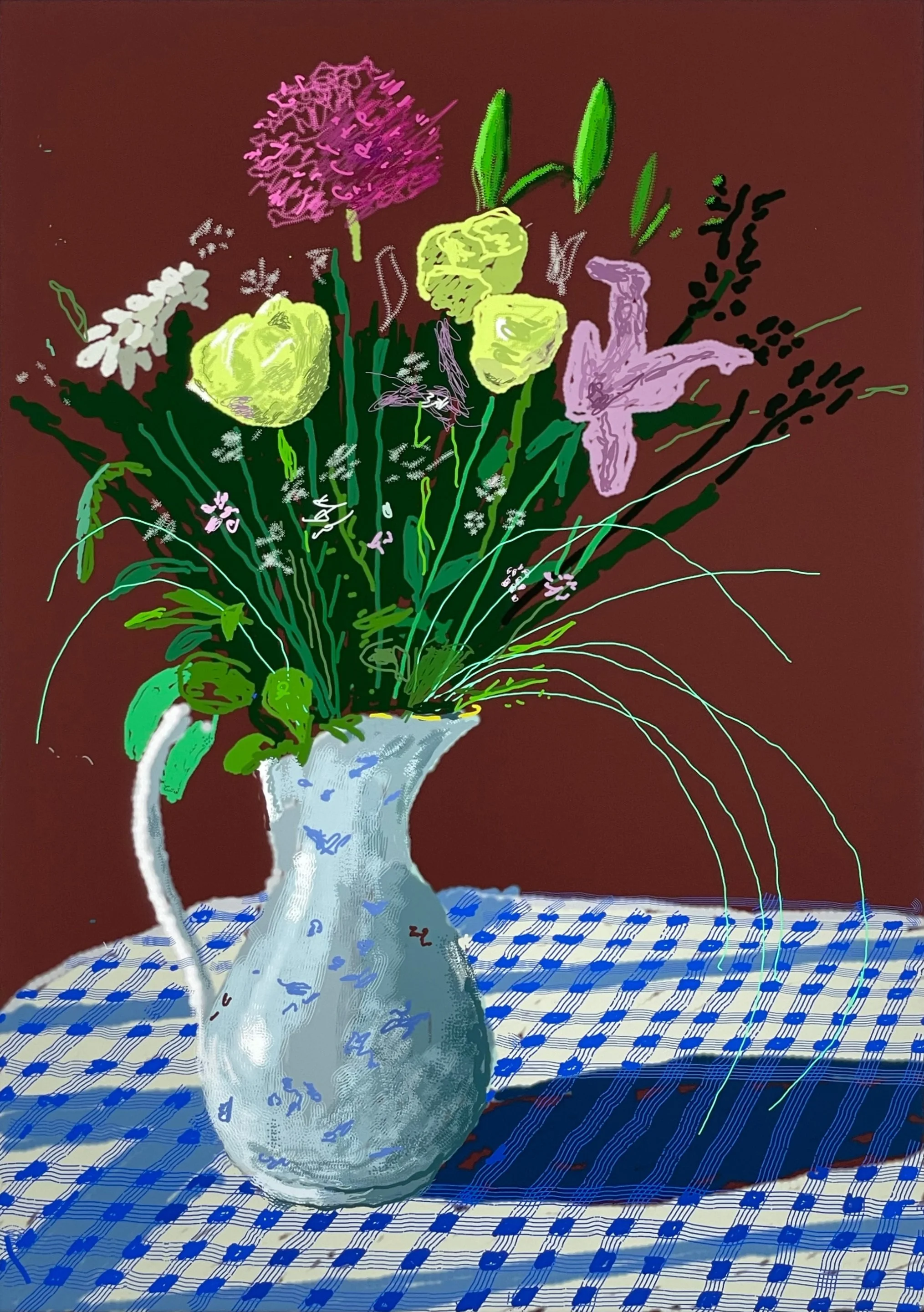
이후 영국 요크셔의 풍경을 중심으로 전개된 대형 회화와 다중 패널 작업에서는 자연의 형태와 계절의 변화, 색채와 공간의 관계가 보다 확장된 구성으로 나타난다. 호크니는 전통적인 회화와 드로잉을 지속하는 동시에 컴퓨터와 아이폰, 아이패드 등의 디지털 매체를 적극적으로 도입했다. 디지털 드로잉과 영상 작업은 제작 도구의 변화에 그치지 않고, 이미지의 생성과 전시, 시각적 경험의 조건을 재검토하는 과정으로 이어졌다.
호크니의 작업은 20세기 영국 팝아트의 역사적 맥락에서 출발했으나, 특정한 양식이나 매체의 범주에 머무르지 않았다. 회화의 전통적인 문제인 시점과 원근, 빛과 색채, 공간과 시간에 대한 지속적인 탐구는 사진과 디지털 기술의 발전과 교차하며 독자적인 조형적 체계를 형성했다. 그의 예술은 전후 구상회화의 전개와 동시대 시각문화의 변화 속에서 회화의 가능성을 확장한 주요한 실천으로 평가된다.
David Hockney was a British artist whose practice explored the possibilities of visual representation and spatial perception across painting, drawing, printmaking, photography, and digital media. Born in Bradford, England, in 1937, he emerged as a significant figure within British Pop Art during the 1960s. Through his distinctive treatment of everyday subjects, portraiture, and landscape, Hockney developed an artistic language characterized by an ongoing investigation into color, pictorial space, and the conventions of representation.
Following his move to Los Angeles in the mid-1960s, Hockney began exploring the architecture, swimming pools, interiors, and figures associated with Southern California. Paintings from this period, including A Bigger Splash, are distinguished by precise contours, expansive areas of flat color, and carefully articulated spatial compositions. His investigations into light, reflection, and the visual properties of water extended the possibilities of figurative painting while reconsidering the relationships between pictorial construction and perception.
From the 1970s onward, Hockney expanded his practice through portraiture, landscape, and photographic experimentation. His photographic collage works, commonly known as Joiners, developed during the 1980s, brought together multiple images captured from different viewpoints and moments in time. By assembling fragmented perspectives within a single composition, these works challenged the conventions of linear perspective and the fixed viewpoint, constructing a complex visual experience in which spatial and temporal relationships unfold simultaneously.
His subsequent engagement with the landscapes of Yorkshire introduced increasingly expansive compositions, including large-scale paintings and multi-panel works that examined natural forms, seasonal transformations, and the relationship between color and space. Alongside his continued commitment to traditional painting and drawing, Hockney incorporated digital technologies, including computers, iPhones, and iPads, into his practice. His digital drawings and moving-image works extended these investigations beyond conventional media, reconsidering the processes through which images are produced, displayed, and perceived.
Although Hockney's practice emerged within the historical context of British Pop Art, it consistently moved beyond the boundaries of any single movement or medium. His sustained examination of perspective, light, color, space, and time developed in dialogue with the changing technologies of image-making, establishing a distinct approach to pictorial representation. Across more than six decades, his work contributed significantly to the development of postwar figurative painting and the expanded possibilities of visual art in the contemporary era.
Selected works